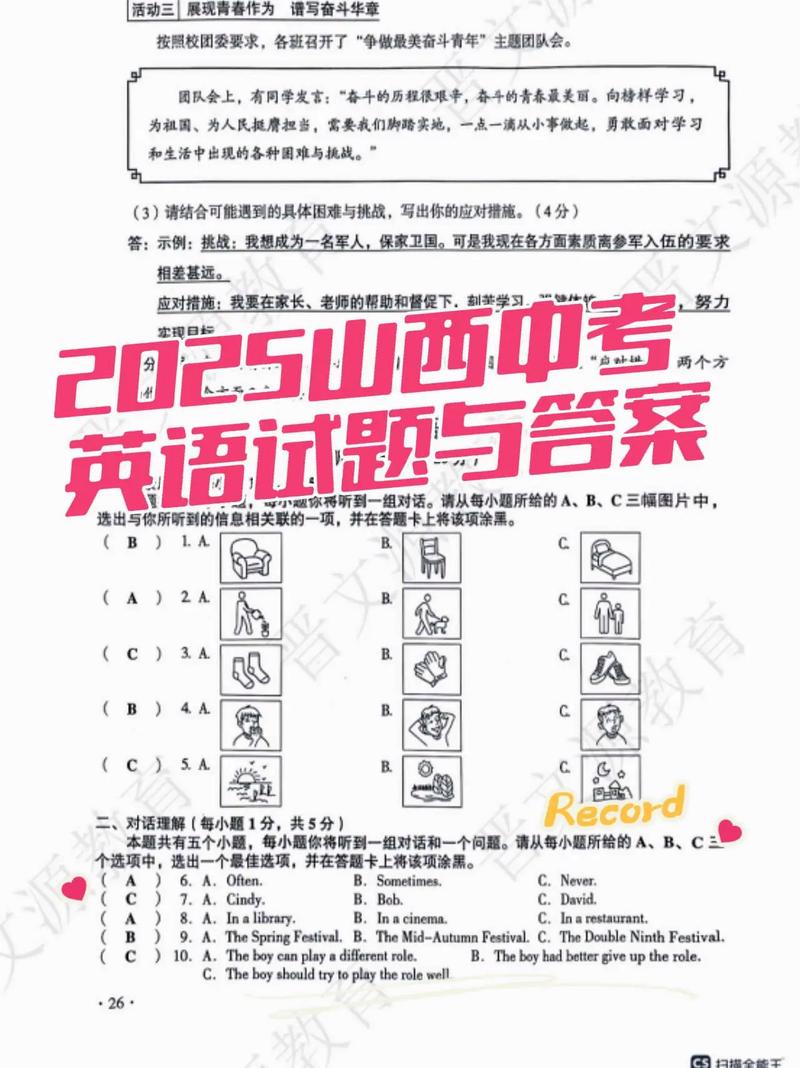
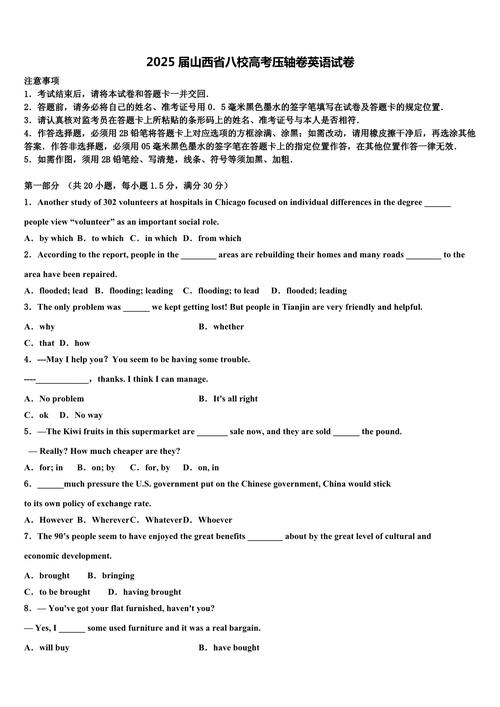
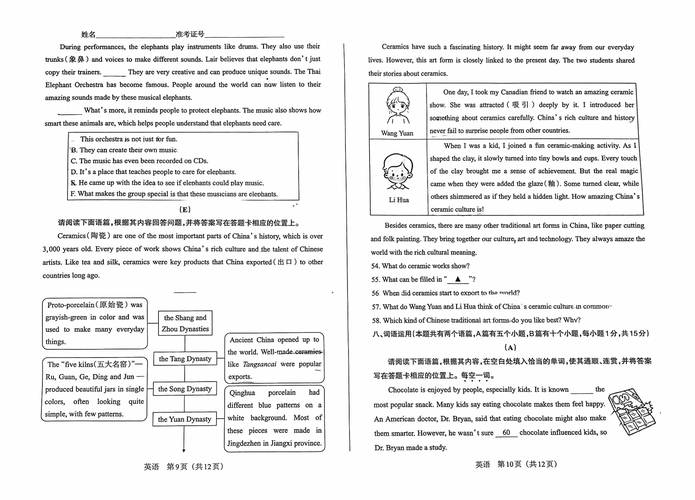
- 回忆版:特岗考试真题通常不会由官方完整公布,以下内容是根据考生回忆、培训机构资料及网络资源整理而成,可能与原题存在细微出入,但核心考点和题型高度一致。
- 价值:这份资料对于备考2025年及以后山西特岗英语的考生具有极高的参考价值,可以帮助您了解考试难度、题型分布、高频考点和命题趋势。
2025年山西省特岗教师招聘考试 英语真题(回忆版)
第一部分:英语知识运用
第一节:单项填空
从A、B、C、D四个选项中,选出可以填入空白处的最佳选项。
-
—I'm sorry, I __ my key at home this morning. —It doesn't matter. Don't forget to take it tomorrow. A. forgot B. left C. missed D. lost
-
__ fine weather it is today! Let's go for a picnic. A. What B. What a C. How D. How a
 (图片来源网络,侵删)
 -
—Do you know __? —Sorry, I don't know. You can ask the policeman over there. A. where is the post office B. where the post office is C. where was the post office D. where the post office was
-
The old man lives __, but he never feels __. A. alone; lonely B. lonely; alone C. alone; alone D. lonely; lonely
-
—I called you at 8:00 last night, but nobody answered. —Oh, I __ a shower at that time. A. was taking B. took C. am taking D. take
-
This is the book __ I borrowed from the library yesterday. A. who B. which C. what D. whom
 (图片来源网络,侵删)
 -
We should try our best to protect the environment __ it is too late. A. before B. when C. until D. after
-
—Could you tell me __? —Yes, there is a bank on the second floor. A. if there is a bank near here B. where is a bank near here C. if was there a bank near here D. where was a bank near here
-
My parents want me __ a doctor when I grow up. A. to be B. being C. be D. am
-
I prefer __ TV at home rather than __ shopping on Sundays. A. watching; go B. to watch; to go C. watching; to go D. to watch; go
第二节:完形填空
阅读下面短文,掌握其大意,然后从各题所给的A、B、C、D四个选项中,选出最佳选项。
Last Friday, a terrible earthquake hit Yushu, Qinghai. It was a very difficult time for the people there. Many houses fell down and many people were 11 . The whole country felt sad for them.
However, soon after the earthquake, help came from all over China and even from other countries. Doctors, nurses, soldiers and volunteers went to Yushu 12 . They worked day and night to save people's lives. They dug people out of the 13 , gave them food and water, and took the injured to hospitals.
People all over the country donated money and things. The money was used to 14 new houses for the homeless. The things, like clothes, tents and food, were sent to Yushu by plane and truck.
It is true that the earthquake brought a great disaster. 15 , it also showed the beauty of humanity. When people are in trouble, we should help each other. Love can make us stronger and help us 16 any difficulty.
-
A. trapped B. saved C. hurt D. found
-
A. slowly B. quickly C. quietly D. sadly
-
A. rivers B. mountains C. ruins D. snow
-
A. build B. to build C. built D. building
-
A. But B. And C. So D. Or
-
A. get over B. get on C. get off D. get into
第二部分:阅读理解
阅读下列短文,从每题所给的A、B、C、D四个选项中,选出最佳选项。
A In many English homes, people eat four meals a day: breakfast, lunch, tea and dinner. People have breakfast at any time from seven to nine in the morning. They eat porridge, eggs or bread. English people drink tea or coffee at breakfast. Lunch comes at one o'clock. It can be a quick meal, but it is often a big meal with meat and potatoes. Afternoon tea is between four and five in the afternoon. It's not a big meal. It's just a cup of tea with cakes or sandwiches. Dinner is the main meal of the day. It's at about half past seven. Some people have dinner in the middle of the day, but in the evening, it's a big meal with meat, potatoes and other vegetables.
-
How many meals do English people have a day? A. Two. B. Three. C. Four. D. Five.
-
What do English people have for breakfast? A. Meat and potatoes. B. Tea and cakes. C. Porridge, eggs or bread. D. Sandwiches and vegetables.
-
When do people have afternoon tea? A. Between seven and nine in the morning. B. At one o'clock in the afternoon. C. Between four and five in the afternoon. D. At half past seven in the evening.
-
What is the main meal of the day for English people? A. Breakfast. B. Lunch. C. Afternoon tea. D. Dinner.
B A young man was getting ready to graduate from college. For many months he had admired a beautiful sports car in a dealer's showroom, and knowing his father could well afford it, he told him that was all he wanted. As Graduation Day came near, the young man waited for the news that he had got the car. On the morning of his graduation, his father called him into his own study. His father told him how proud he was to have such a good son, and handed him a beautifully wrapped gift box. Curious, the young man opened the box and found a lovely, leather-bound Bible (圣经). Angrily, he raised his voice to his father and said, "With all your money you give me a Bible?" He then rushed out of the house, leaving the Bible. Many years passed and the young man was very successful in business. He had a beautiful home and a wonderful family, but realizing his father was very old, he thought perhaps he should go to see him. He had not seen him since that graduation day. Before he could go, he received a telegram telling him his father had died. He had to go back immediately and take care of the things that would be left to him. When he arrived at his father's house, sudden sadness and regret filled his heart. He began to search through his father's important papers and saw the still new Bible, just as he had left it years ago. As he opened the Bible, a car key dropped from the back cover. It had a tag (标签) with the dealer's name, the same dealer who had the sports car he had desired. On the tag was the date of his graduation, and the words "PAID IN FULL".
-
What did the young man want as a graduation gift? A. A Bible. B. A sports car. C. A leather-bound box. D. His father's love.
-
How did the young man feel when he got the Bible? A. Proud. B. Surprised. C. Angry. D. Disappointed.
-
What happened to the young man's father? A. He gave his son a car. B. He died before his son came back. C. He was very successful in business. D. He regretted giving his son the Bible.
-
What was the tag on the car key for? A. To show the car had been paid for. B. To show the date of his graduation. C. To show the name of the dealer. D. To show his father's love.
第三部分:英语教学知识与能力
这部分是特岗教师考试的特色,主要考察教育教学理论。
- The main purpose of English teaching in primary school is to __. A. help students get high scores in exams B. develop students' basic language skills and interest in English C. teach students a lot of English grammar rules D. make students remember as many words as possible